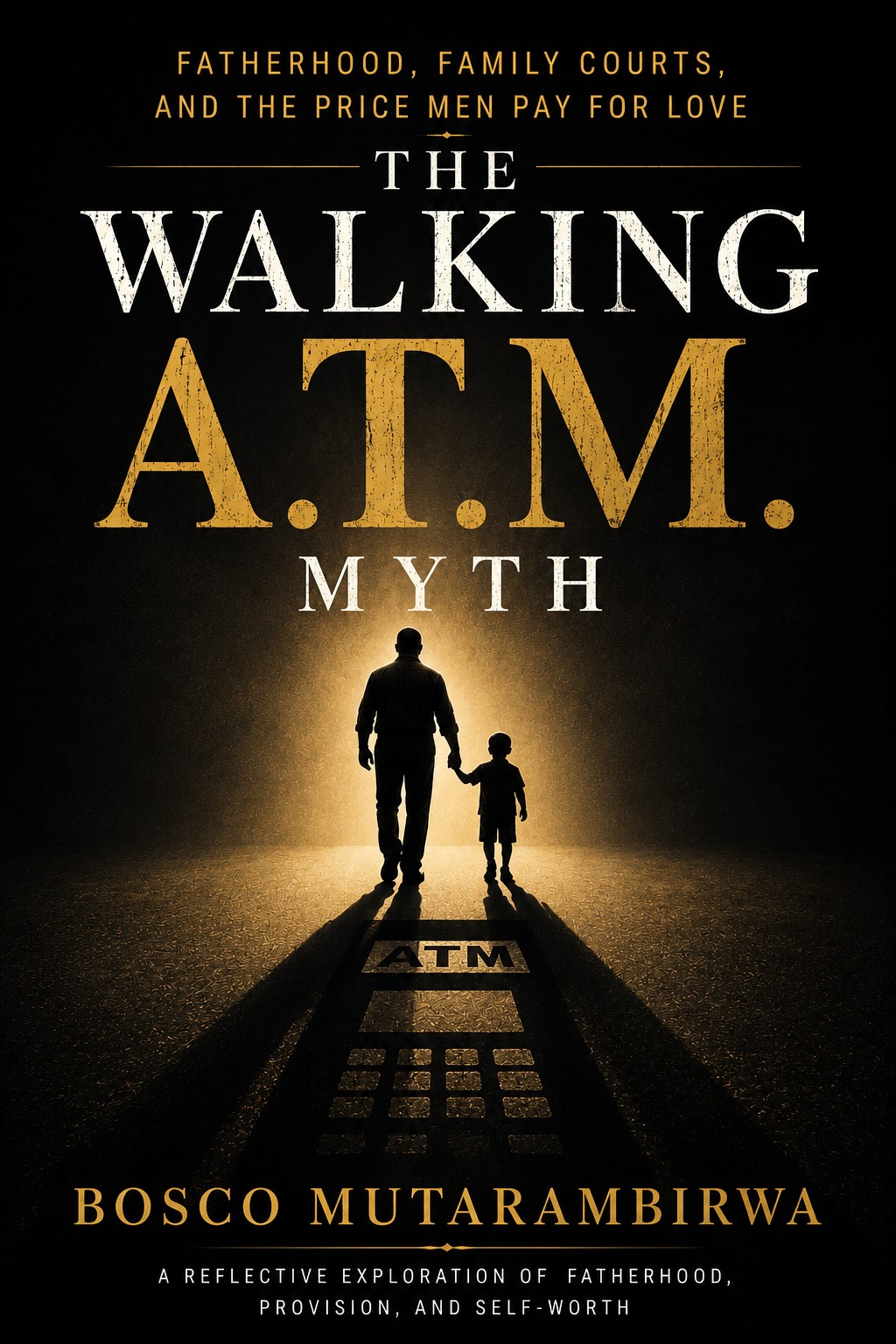
TRANSLATION LANGUAGES CURRENTLY SOUGHT
• French
• Portuguese — Brazilian Portuguese strongly preferred
• German
• Japanese
• Spanish
• Dutch
Please submit offers only for these languages.
Translators with experience in family and relationships, fatherhood, psychology, self-help, or emotionally nuanced narrative nonfiction are strongly preferred. The translation must preserve the book’s compassionate tone and avoid turning its reflections into blame.
Sometimes fathers joke that they feel like walking ATMs. The Walking ATM Myth argues that the feeling is not really about money. It is about what happens when love, responsibility, usefulness, and self-worth become difficult to separate.
Through the story of David and the experiences of many caring fathers, the book explores why provision can become identity, why saying no can trigger guilt, and why relationships may feel uncertain when children grow up and the phone rings less often. It examines the quiet emotional labor behind constant problem-solving and the fear that being needed is the same as being loved.
This is not a book about blaming fathers or families. It is a compassionate guide to noticing unhealthy patterns, communicating more honestly, setting sustainable boundaries, and building relationships that are based on connection rather than rescue.
Readers interested in fatherhood, parenting adult children, family dynamics, masculinity, boundaries, guilt, emotional well-being, and personal growth will find a reflective path toward a fuller identity—one that values a father for who he is, not only for what he provides.
Genre: FAMILY & RELATIONSHIPS / Parenting / FatherhoodThe English edition is a newly published 2026 independent release and does not yet have a notable sales ranking. Its themes—fatherhood, provision, family expectations, guilt, boundaries, and relationships with adult children—are widely recognizable across cultures. The manuscript is approximately 26,937 words and combines reflective nonfiction with an accessible narrative thread. The author will support translated editions through DarwinPublications.com, Goodreads, LinkedIn, and related book-promotion channels.
Most fathers can remember a moment when something felt different.
Perhaps a child called only when a problem needed solving. Perhaps a family expense appeared without discussion because everyone assumed Dad would handle it. Perhaps the house grew quieter, the children became adults, and the father who had spent years being indispensable suddenly wondered where he fit.
Most fathers do not resent helping. Provision can be an expression of love, responsibility, pride, and commitment. Yet over time admirable instincts can grow beyond healthy boundaries. Helping becomes identity. Responsibility becomes self-worth. Usefulness becomes the primary measure of value.
That is the walking ATM myth: the belief that a father’s place in the family depends on what he can pay for, fix, arrange, or rescue.
The Walking ATM Myth is not a book about blaming fathers or families. It is about understanding how a loving role can become a limiting identity—and how fathers and the people who love them can build relationships rooted in connection rather than constant provision.
| Language | Status |
|---|---|
|
French
|
Translation in progress.
Translated by Pascale Vaillancourt Lépine
|